Red Blood Cells
|
|
|
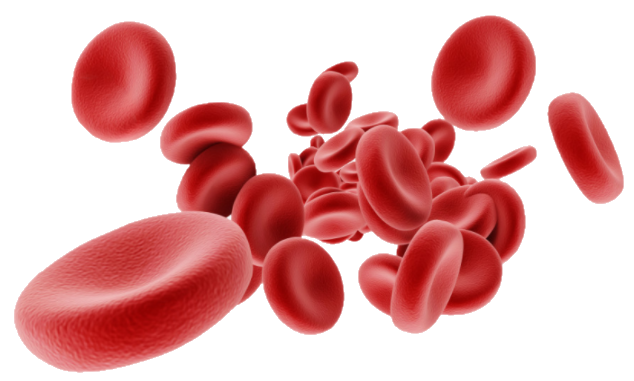
Red Blood Cells - The job of the red blood cells is to carry oxygen in the blood. They are quite unique in as much as they do not have nuclei, which provides more room for Haemoglobin to be carried. Haemoglobin is the red pigmentation which carries the oxygen in the cell. They have a bi-concave shape which looks like a small piece of red plasticine which you might have formed into a disc or ball and then squeezed both sides with your thumb and forefinger. The red pigmentation, as mentioned before is due to the presence of a complicated molecule Haemoglobin. Haemoglobin is a complex molecule containing an atom of Iron at the centre. |
|
|
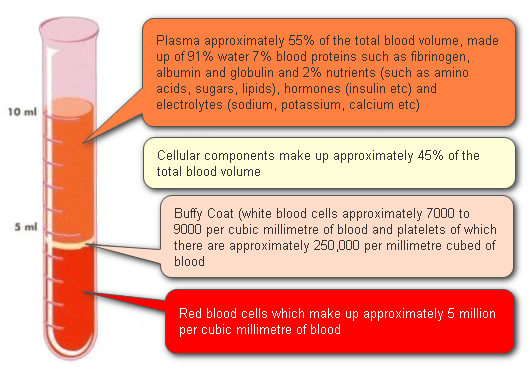
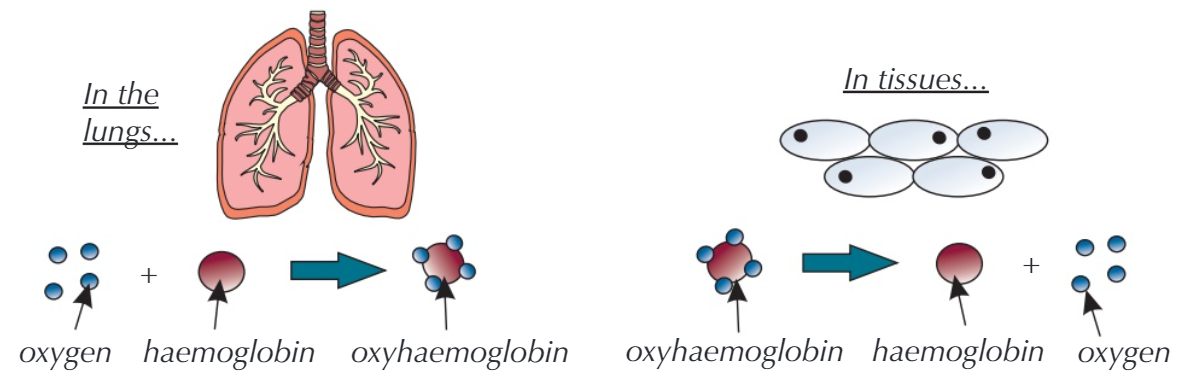
Plasma makes up 55% of the volume of blood and is a solution of many different chemicals in water. For example, the plasma contains dissolved glucose, amino acids and other products of digestion from the intestines. It also transports the waste molecule urea from the liver where it is made to the kidney where it is excreted. Blood plasma contains dissolved carbon dioxide, mostly in the form of hydrogencarbonate ions. Many hormones (for example testosterone, ADH, adrenalin) are transported in the blood plasma and because the plasma is mostly water, it provides a good way of moving heat around the body from respiring muscles to the skin where it can be lost. The most common cell in blood are the red blood cells (or erythrocytes). These tiny cells are adapted for the transport of oxygen. Each red blood cell contains around 270 million molecules of a transport protein, haemoglobin. Each molecule of haemoglobin can bind up to four molecules of oxygen in the lungs and then unload the oxygen when the red blood cell passes through a capillary in an actively respiring tissue. |
|
|
|
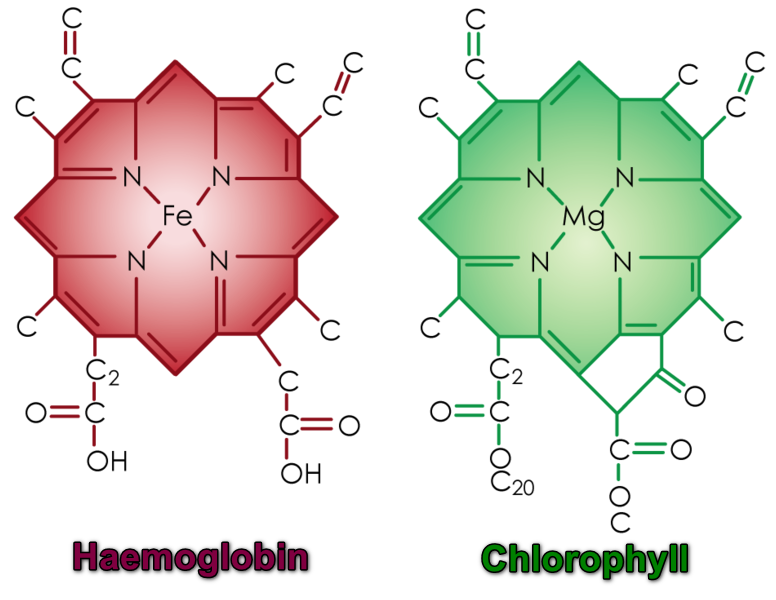
Interestingly, the next graphic shows you the molecular construction of haemoglobin and compares it to the molecular structure of chlorophyll. As you know both of these molecules are involved extensively with oxygen.
Oxygen binds to haemoglobin to be carried around the bloodstream, being dropped off at cells which need it, and chlorophyll is active in the production of oxygen during the process of photosynthesis.
You can see that there are many similarities!