Division
Just as multiplication involved “carrying”, division will involve “borrowing” and out of the two (multiplication and division) division is considered to be the hardest.
Example 1
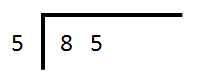
We lay out the multiplication using hundreds tens and units, and if necessary thousands tens of thousands or even higher but with division the layout appears differently.
In some books you will find the upright bar is curved inwards like a right-hand parenthesis, and in some books the 2 bars won’t even be there, instead there will be a box. I prefer this “upright and horizontal bar” method because it is the way that I was taught to do long division many years ago. Unlike in multiplication where we start with units, in long division we approach the problem number (85 in this case) from left to right irrespective of its size. Okay, let’s see how many fives there are in 85:
Step 1: working from the left, we first of all ask ourselves “how many fives in 8?”
There is one 5 in 8, so we enter a one above the 8 (shown in green) and we subtract 5 from the 8 leaving a remainder of 3 which we write underneath the 8 as shown.
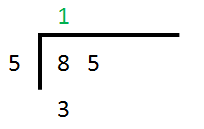
We now bring down the 5, making the 3 into 35.
Step 2: again working from the left, we now ask ourselves “how many fives in 35?”
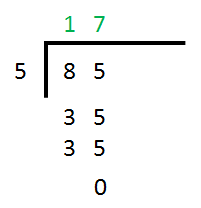
If you’re not sure of the answer, refer to the grid a few pages back, find 35 in the grid and with number 5 itself as either the side or top header, move sideways or upwards and you will find that there are in fact 7 fives in 35.
We put 7 above the 5 as shown in green and we take the 35 from 35 leaving 0.
Because we have nothing left, we have in fact finished and the answer is 85 ÷ 5= 17.
That was a fairly straightforward example, in fact if you look at the grid of the 20×20 times table you could’ve just simply read the answer straight off.
Example 2
For our next example I’m going to make it considerably more complicated but the answer will still be a whole number although entering decimal numbers in long division isn’t really that much more complicated.
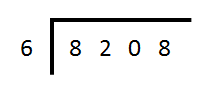
You are certainly not going to be able to look this one up as easily so we are going to have to go through it the hard way.
Once again, our first step is to work from left to right, and the 1st thing we ask ourselves is “how many sixes in 8?”
Well, there is one 6 in 8, and when we take it from 8 it leaves us with a remainder of 2, we indicate the result of this particular operation this way:
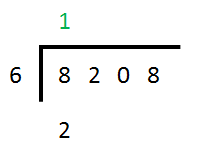
The next thing that we do is bring down the 2 (in 8208) making “22” on the bottom line. We ask ourselves “how many sixes in 22?”
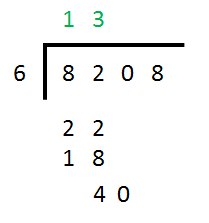
We conclude that there are 3, with a remainder of 4. Again, this will be shown in the following diagram.
We bring 0 down to turn the “4” into “40”, we ask ourselves “how many sixes in 40?” And again we conclude that there are 6 sixes in 40 with a remainder of 4 (6×6 equals 36, 40 – 36 = 4)
We put a 6 to the right of the 3 in the answer, we take 36 from 40 leaving 4 and bring down the remaining number which is the 8, and our expression now looks like this:
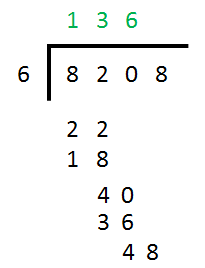
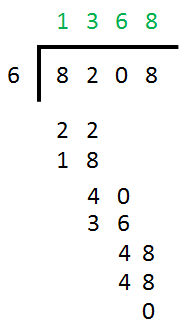
We are almost at the end of the question, we now ask ourselves for one final time “how many sixes in 48?”, And referring to the table above (the multiplication table that is) we can see that there are in fact 8 sixes in 48.
We place an 8 to the right of the 6 in the answer; we subtract 48 from 48 leaving 0 which indicates that we have in fact completed the question and that the answer is 1368.
I think you’ll agree that long multiplication is simpler, but long division is not necessarily complicated, perhaps a little bit fiddly and you have to really keep on top of those subtractions!